Finance your company with tokenized bonds.
Your company issues debt for a term and at an interest rate, through bonds and debentures over several years or short-term promissory notes, and the registry entity (ERIR) records it in a digital registry. You do not give up equity or voting rights. You prepare the issuance with your law firm and open it to your investors from a single account.
What it is
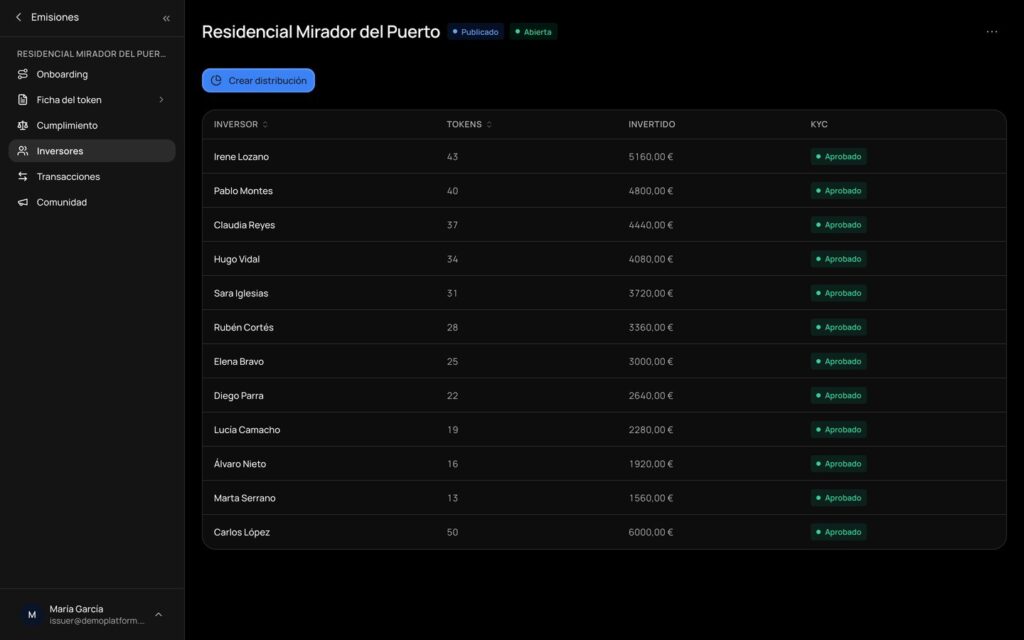
A tokenized bond is still a bond. What changes is where it is recorded. It moves to a register based on distributed ledger technology (DLT) kept by an authorized entity, the ERIR. Whoever subscribes to it lends money to your company. They have the right to collect the agreed interest and to recover what they put in at maturity. They become a creditor of your company and have no vote. You see the list of holders in your dashboard, always up to date.
Bonds and obligations have the same legal regime.
- TodayYou receive the amount lent
- Period 1You pay the interest
- Period 2You pay the interest
- Period 3You pay the interest
- MaturityYou repay the principal and the final interest
Example amounts. The subscriber is a creditor. They are entitled to receive payment, but they do not vote.
Bond, debenture or promissory note: which to choose.
All three are debt. Your company receives the money and repays it on the agreed date, without giving up equity or voting rights, and the law applies the same legal regime to them. They vary in term and in how the investor gets paid.
| Promissory note | Bond | Debenture | |
|---|---|---|---|
| Timeline | Short term, from seven days to 25 months | Medium and long term, shorter than the debenture | Medium and long term, up to 30 years |
| How the investor gets paid | The investor subscribes to it below its value and receives the full value at maturity | The investor receives fixed or variable interest and recovers their principal at maturity | Same as with a bond |
| What it is useful for | Working capital and timing gaps between payments and receipts | An investment you repay in a few years | Long-term projects, such as real estate or a power plant |
If you are going to repay the money in less than two years, the promissory note suits you, and it has its own page: promissory notes. If you need several years and can pay interest in the meantime, the bond or the debenture suits you. Your law firm chooses the name based on the term and writes it in the issuance document.
When it fits and when it doesn't.
It fits if
- Your company is an S.A., or an S.L. that fits within its issuance limit.
- You want to obtain financing without giving up equity or voting rights.
- You can pay interest and repay the principal on the dates you set.
- You have your own investors to invite.
It does not fit if
- Your S.L. needs more than twice its equity and cannot provide guarantees. See the participating loan or convert it into an S.A.
- You need the money for less than a year. See the promissory notes.
- You cannot commit to periodic payments. Shares do not require them.
- You expect someone to find investors for you. HokenFi does not find them.
What you decide.
Your law firm puts it in writing in the issuance document.
- 01The issuance amount and the nominal value of each bond
- 02The term and the maturity date
- 03The interest rate and how often you pay it
- 04The guarantees, if you offer them
- 05The order of payment relative to your other creditors
- 06The minimum investment per investor
- 07The subscription period
- 08Who are you targeting, only qualified investors or the general public
- 09The network, Ethereum or Polygon
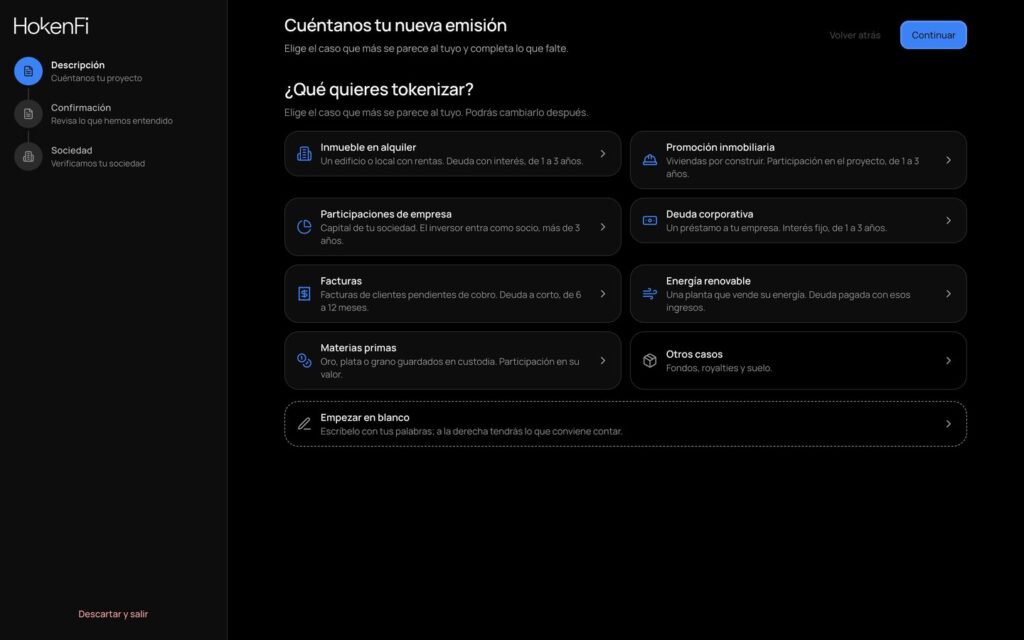
Step by step, in a single account.
- 01
You state what you want to issue
The asset, the amount and the term. With that, the platform prepares the milestones for your issuance.
- 02
Your company
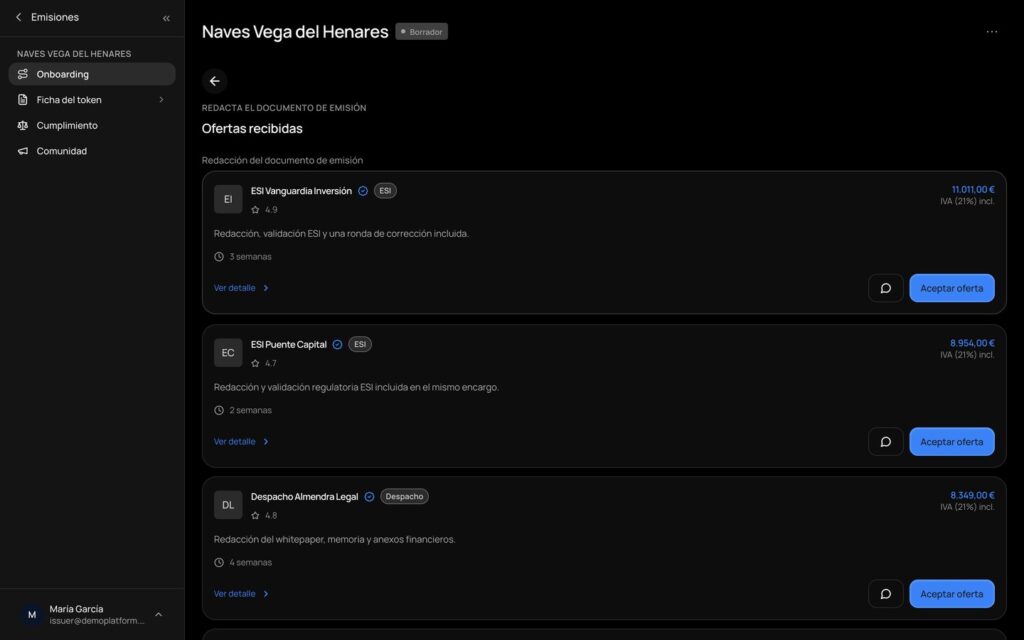
If necessary, a corporate law firm creates the issuing company or transforms yours into a public limited company. You request quotes and choose without leaving the account.
- Be a public limited company (if you already are, or your S.L. fits within its limit, you skip it)A law firm
- Prove the financial backingYou
- 03
Your issuance document
It is drafted by a law firm specializing in securities or an investment services company (ESI). You also choose it by quotes.
- Draft the issuance documentA law firm specializing in securities, an ESI, or you
- 04
Your issuance
- Activate your planYou
- Create the tokensYou
- Finalize the final documentYou
- 05
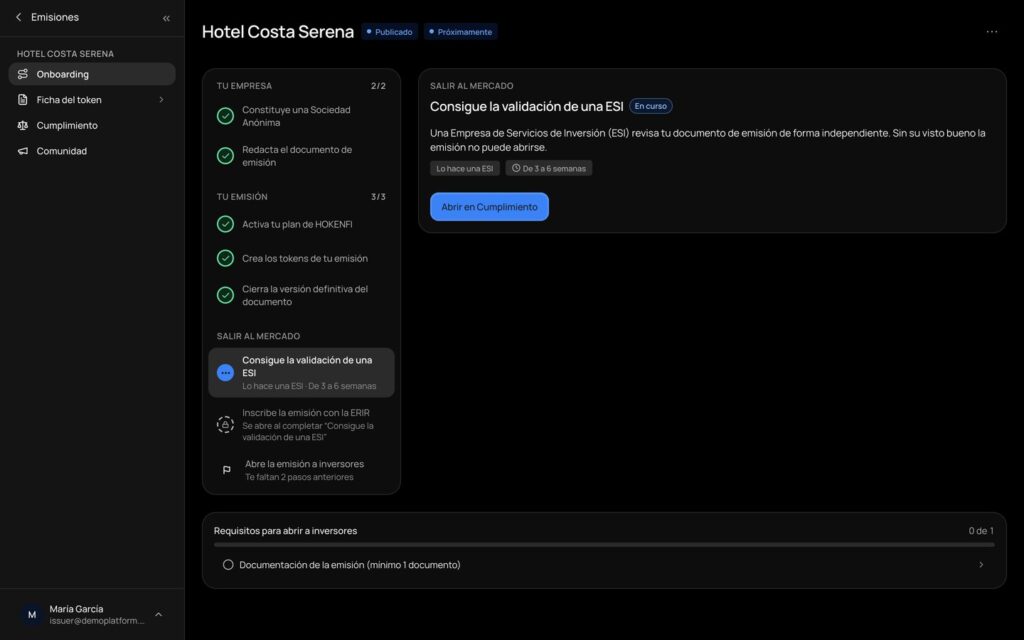
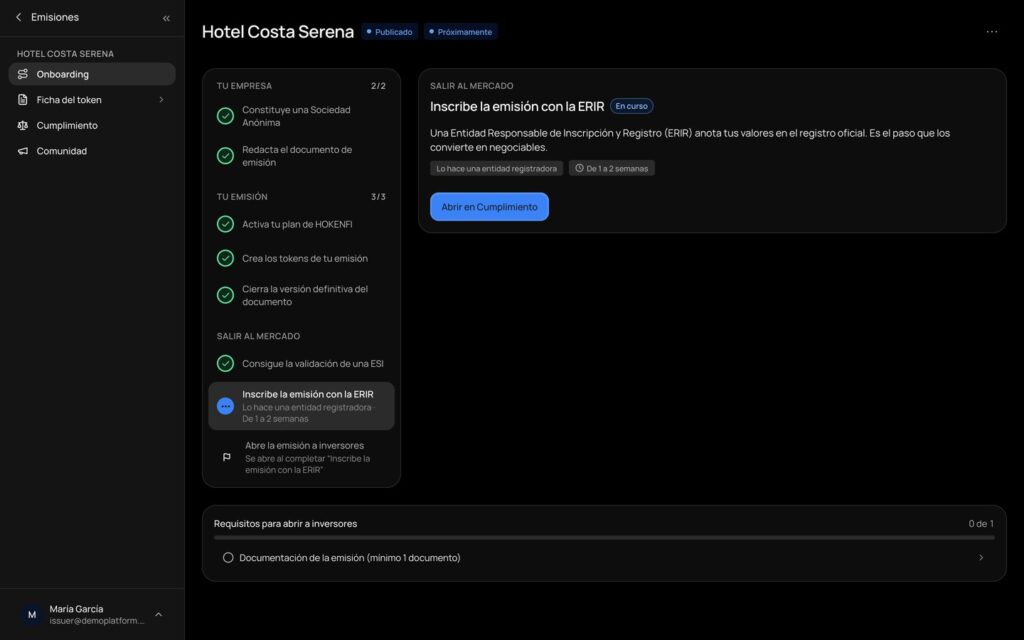
Go to market
- Validation of the offer, when required by lawThe ESI
- Registration of the bondsThe ERIR
- Collection account for the issuance, with its own IBAN (automated IBAN plugin, 150 € per month, or included in Scale and Institutional)You
- 06
You open to your investors
They are verified, subscribed and paid by bank transfer into your issuance account. The ERIR records them as holders and you see the list in your dashboard.
In Spain, today
As of 1 October 2026, the register of the National Securities Market Commission (CNMV) records 21 tokenized issuances for 77,925,715 €. Of these, 17 are debt, for 65.85 M€, and all are bonds.
They range from 209,900 € to 7,962,000 €. One was issued by an S.L.
All have Ursus-3 Capital as ERIR, the only investment services company that the CNMV lists as ERIR. The first tokenized issuance was published in February 2025 and was for bonds.
Source: CNMV public registry, as of 1 October 2026.
What beginners usually ask.
Can my S.L. issue bonds?
Yes, with a cap. The total of its issuances cannot exceed twice its equity, unless the issuance is secured by a mortgage, pledge of securities, public guarantee or joint and several guarantee from a credit institution. With a guarantee from a mutual guarantee company (SGR), the limit is set by its guarantee capacity. The S.A. does not have that cap, which is why it is a better vehicle to issue.
Who approves the issuance?
The management body, unless your articles of association say otherwise. The general meeting only has to approve it if the bonds can be converted into shares or give a share in profits.
Do I need a prospectus?
In general no, if you are below 8 million in twelve months. From June 2026 the European regulation sets that figure at 12, unless a country opts for 5, but Spanish law still says 8, so your law firm confirms the one in force. Yes, you need the issuance document.
When is an ESI required?
When the issuance is without a prospectus and you offer it to the general public with advertising. The ESI validates the information your investors receive and supervises the marketing.
Is a commissioner needed?
Yes, if you offer the bonds to the public with a prospectus, or without one because it is below the amount threshold. The law requires a syndicate of bondholders and a commissioner to represent them. Your law firm provides for it in the issuance.
Does the CNMV approve my issuance?
No. The CNMV registers the ERIR as responsible for the registration of your issuance, and that registration does not imply that it has validated the terms or the information.
How much does it cost?
You pay a one-time access fee of 249 € when creating the account. The plan, from 249 € per month, you do not pay until you launch the issuance. The fees for the law firm, the ERIR and the ESI are separate and you see them in each offer before signing. Add the notary and the Commercial Registry. Prices exclude VAT.
Do you want to finance yourself without giving up equity? Tell us about your issuance.
Create your account, activate access and you will receive offers from law firms.